
Beer, bikes, and ... polka A Friday night dispatch in which proselytizing
pedal-pushers descend on the They start to gather under the Picasso sculpture around 5 p.m., bundled in varying synthetic fabrics--a little fleece here, a little GORE-TEX there--mingling about before they jump on their bikes and disrupt Friday rush-hour traffic. They, in this case, are a motley collection of avid and casual bicyclists who gather on the last Friday of every month for Critical Mass, "a free, non-athletic bike parade that lasts about two hours," according to the introductory statement on the group's 2002 calendar. Last month I was one of them. The rather bland description from the calendar
doesn't quite get at the Critical Mass idea. The rides are designed
to raise awareness of bicycles as a utilitarian, energy-efficient
travel option. Think "Up With Bikes." (Sometimes literally. During
a ride, cyclists often stop in mid-intersection and hoist their
bikes over their shoulders in a slightly ironic militant-biker pose.)
I've done a few of these rides before, and in the interest of full disclosure I should say I know many of the people involved. Last month's ride, however, was a particularly prime CM event, aside from the ridiculously warm weather, the Jan. 25 trek was the third annual Critical Mass Polka Ride. The rides in general tend to have a rollicking, boisterous tone--whistles, bullhorns, bells, and shouts--as the riders pedal through the Loop and beyond. The Polka Ride was no exception, with the addition of polka music blaring from a beat-up boom box secured to the back of one rider's mountain bike.
The ride weaved through the South Loop, Chinatown, Bridgeport, and Gage Park, zigzagging on and off Archer Avenue (home of the Polka Music Hall of Fame, by the way) for nearly the entire route. There was a pit stop at 35th Street for gut-busting Huck Finn donuts. (An excellent digestive base for the copious amounts of beer that would be guzzled later in the evening.) The ride was a relatively orderly affair, looking
almost like a bike race. On the busy four-lane streets, such (The ride doesn't go fast, but you don't want to lollygag, because you'll get cut off at busy intersections and loose out on the mild thrill of forcing a miniature traffic jam. I learned this the hard way during the Polka Ride.)
When I caught wind of this plan I happened to be near the front of the pack, so when the lead riders made their beeline for the Baby Doll I tried to keep pace, understanding what was at stake. And, well, let's just say I'm no Lance Armstrong. It didn't take long for half a dozen riders to zip by me, leaving only the whish-whish sound of their pedaling and the faintly blinking red lights of their rear reflectors for me to consider. I did eventually make it to the Baby Doll, about 30 seconds before the horde of other riders. More than 75 sweaty, thirsty cyclists filed into the small bar and immediately hit the dance floor. (Impressive stamina in this bunch.) I grabbed an open seat near the bar and watched the festivities. The Baby Doll is not a large space and the dance floor is tiny. Nonetheless, it was packed with riders bopping to hard-rock polka.
And Critical Mass is nothing more than a rowdy, rolling group of grungy bike messengers proselytizing the benefits of the bicycles for the car-dependent masses. It's a simple surface parallel, to be sure, but the polka-biker connection goes deeper. Oh yes, much deeper. What if I told you that behind the slacker facade of Critical Mass there was a tightly run network of committed activists carefully consolidating political power at a citywide level? You'd say I was nuts, of course. Maybe.
Ask for a yard and you may get a foot, or rather, ask for the Drive and you may get Columbus. Members of the group have said as much. It's a classic tactic of community organizing. They've done a bang-up job on the publicity front as well, convincing Tribune columnist Eric Zorn to take a ride and devote a column to the cause. This newspaper has certainly given them coverage, along with periodic stories in both dailies. The group has come a long way from its humble
beginnings five years ago There are now several off-shoot Here's the key, though. The CM-ers now have someone working for the city. Yessir, they have someone on the inside handling "bike issues." Those issues may be fairly innocuous, like suggesting where to install bike racks, but I suspect they're merely biding their time. They're skipping over the notion of installing someone at the politically ineffectual Park District and taking their cause straight to City Hall. Seems like a smart move--almost calculated, don't you think?
By the mid-1800s, polka dancing was all the rage in Prague and Paris, causing a famous French dance master to declare: "What young man is there, although formerly most opposed to dancing, whom the polka has not snatched from his apathy to acquire, willy-nilly, a talent suddenly become indispensable?" Exactly. A few songs and a few drinks later, I was singing--not lip-synching, mind you--the words to "Old Style Beer Polka." I was, actually, shouting the words, "We're Livin' Old Style, Old Style Beer," as loud as I could without hurting a vocal cord. Then, with virtually no coaxing, I grabbed my wife and trotted on to the postage stamp-sized dance floor. We did our best impression of a polka: Attached in a standard slow-dance pose we tilted back and forth in time, spinning in an awkward circle with other couples bouncing off our sides. It was essentially a polka mosh pit. And there I was, apathy dissolved, hopping and singing "willy-nilly" in a whirl of polka passion. |

 The
end point of the ride was the Baby Doll Polk Club, by Midway Airport,
a good 15 miles from the Daley Plaza starting point. The Polkaholics,
a local band that plays (as they explain in one of their songs)
polka with guitars, would provide the evening's entertainment.
The
end point of the ride was the Baby Doll Polk Club, by Midway Airport,
a good 15 miles from the Daley Plaza starting point. The Polkaholics,
a local band that plays (as they explain in one of their songs)
polka with guitars, would provide the evening's entertainment. 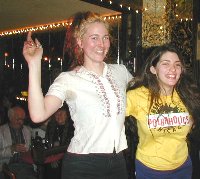 as Archer, riders remained in the far right lane, allowing cars
to pass on the left. On the side streets, we took over, forcing
motorists to stop while we cruised by waving. A note to future riders:
Major intersections can be tricky. Typically, a few lead riders
will go ahead and secure the intersection by blocking off traffic,
until all the riders pass through.
as Archer, riders remained in the far right lane, allowing cars
to pass on the left. On the side streets, we took over, forcing
motorists to stop while we cruised by waving. A note to future riders:
Major intersections can be tricky. Typically, a few lead riders
will go ahead and secure the intersection by blocking off traffic,
until all the riders pass through. 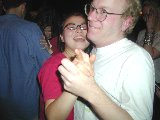 Experienced
CM-ers took the last leg of the ride as a call to race, the goal
being an excellent bike parking spot and the chance to get a drink
before the rest of the riding riffraff arrived.
Experienced
CM-ers took the last leg of the ride as a call to race, the goal
being an excellent bike parking spot and the chance to get a drink
before the rest of the riding riffraff arrived.  Combining
the Critical Mass ride and a long night of polka music is a natural
fit if you think about it. Polka
Combining
the Critical Mass ride and a long night of polka music is a natural
fit if you think about it. Polka  music
is rowdy, rolling and democratic--anyone can sing along, and within
the simple polka beat, you can throw in almost any words that come
to mind. How much songwriting craft went into the classic "I Don't
Want Her, You Can Have Her, She's Too Fat For Me"?
music
is rowdy, rolling and democratic--anyone can sing along, and within
the simple polka beat, you can throw in almost any words that come
to mind. How much songwriting craft went into the classic "I Don't
Want Her, You Can Have Her, She's Too Fat For Me"?  Remember
the
Remember
the  bike
groups, a Web site, a zine, and the aforementioned slick new calendar
that CM-ers have been handing out
bike
groups, a Web site, a zine, and the aforementioned slick new calendar
that CM-ers have been handing out  And
what grand scheme lurks behind polkas? Sure, there's a certain innocuous-ness
to the whimsical music, but don't think for a minute it's not trying
to put you under its spell and convert you to a polka way of life.
Defined as a "vivacious" couple dance of Bohemian origin, polka
was first introduced into the ballrooms of Prague in 1835. The name
of the dance (pulka) is Czech for "half-step," referring to the
rapid shift from one foot to the other, according to CentralHome,
a Web site dedicated to dance history and promotion.
And
what grand scheme lurks behind polkas? Sure, there's a certain innocuous-ness
to the whimsical music, but don't think for a minute it's not trying
to put you under its spell and convert you to a polka way of life.
Defined as a "vivacious" couple dance of Bohemian origin, polka
was first introduced into the ballrooms of Prague in 1835. The name
of the dance (pulka) is Czech for "half-step," referring to the
rapid shift from one foot to the other, according to CentralHome,
a Web site dedicated to dance history and promotion.